

You Cannot Return Home as the Person Who Left
Odysseus survived by becoming Nobody, then lost ten years the moment he said his name. If the win that was supposed to settle everything didn't, this is the reason.

Two of his men are dead, eaten in front of him. Two more will be gone by morning.
The giant sleeps by the fire. The sword is right there on the man’s hip, and drawing it would kill everyone, because the stone sealing the cave weighs more than their ship and the only arm strong enough to move it belongs to the creature he wants to stab.
So he does the thing no hero of the Iliad would have done: he waits, watches, and learns the animal’s routine.
And when the giant wakes and demands his name, he surrenders the one possession a Greek warrior never gives up.
Outis, he says.
Nobody.
That is Odysseus, in the cave of the Cyclops, a scene Nolan has just put back on screens everywhere. It is also the scene I keep returning to, and not because of the monster.
There is a kind of success that stops working without ever failing. The company sells. The title arrives. The number clears. And the feeling all of it promised never shows up.
What shows up is a silence, carrying a question you would not say out loud at dinner: is this it?
Most accomplished people answer that question by finding another mountain. I did, and I was good at it. Three companies built, three companies sold, and at the end of it a man with nothing left to prove and no idea what to do next.
The silence, I eventually understood, was an assignment. And the man who had earned all of it was precisely the wrong man to complete it.
What follows is what Homer understood about that silence, what it cost me to learn the same thing myself, and one practice you can run this week to find out how tightly your own name still holds you.
What Homer put in the cave
The conversation around the film has fixed on the spectacle. The instruction is in the cave.
Odysseus cannot escape Polyphemus by fighting harder. He survives through mētis: adaptive intelligence, the ability to read a changing situation, restrain the heroic impulse, conceal himself, improvise, and become whatever the moment requires.
The trick works exactly as intended. Blinded, Polyphemus roars that Nobody is attacking him. His neighbors hear precisely that, take it for a man complaining of nothing, and return to their own caves.
At dawn the men escape tied beneath the sheep while the giant runs his hand across their backs, feeling for men, never thinking to feel underneath.
Odysseus survives because he can temporarily relinquish the identities of king, warrior, conqueror, and hero.
Depth psychology would later give such deep patterns a name, archetypes, inherited shapes of energy we carry and often mistake for ourselves. They deserve an essay of their own, and one is coming. What matters in the cave is that Odysseus can set one down when the moment demands it.
Then he reaches open water, and he cannot bear it. He turns and shouts his name across the sea so the giant will know who beat him.
That need to be credited hands Polyphemus exactly what he needs to call on his father Poseidon, and it costs Odysseus ten years.
The man capable of becoming Nobody is saved. The man who reclaims his heroic identity too soon places himself and everyone around him in danger again.
My own version
This story has become increasingly personal for me.
In my mid-forties, I completed my third entrepreneurial exit. From the outside, it looked like the culmination of the life I had spent decades building.
I had developed the ambition, endurance, and professional competence required to create companies, assume responsibility, solve difficult problems, and keep moving toward the next consequential objective.
None of this was false or pathological. It was the appropriate work of the first half of life.
The first half asks us to build a capable ego, establish a place in the world, form a serviceable persona, and become someone who can act effectively in work, love, and community.
We need a name. We need an answer to the question, “Who am I?” Achievement gives that answer structure, substance, and social reality.
Trouble begins when the persona that helped us enter the world becomes the only self we know how to inhabit.
By the time of that third exit, I had become overidentified with the successful entrepreneur. I had learned the persona so thoroughly that I experienced it as the whole of me.
There is a physical version of this claim. Neuroscientists call it the default mode network, the set of regions that comes online the moment attention is not occupied by a task. Much of what it does is rehearse the self: the autobiography, the standing, the next move. It is the machinery of self-reference, and it runs by default, which is what the name means. If you have spent any time in depth psychology, this is the nearest thing the brain has to an address for the ego.
So a persona practiced for decades goes deeper than behavior. It becomes the material the default mode network keeps rehearsing while you are not watching, which is part of why insight alone so rarely dislodges one. You can know the story has become too small and still find it playing every time things go quiet.
The accomplishment that should have confirmed my direction created enough silence for me to hear what had been neglected. What first appeared as restlessness was, in retrospect, the beginning of a different developmental assignment.
The values and strategies that carried the morning of my life could not, by themselves, carry its afternoon.
I did not yet have the language I now have thanks to Depth Psychology, though I was already moving through the same cycle.
The ego’s account was familiar: identify the next venture, choose the next goal, find another arena in which to prove myself. Beneath that ego-wish lived a less convenient soul-demand. A life organized almost entirely around outward achievement had become too narrow for the person I was becoming.
I had to learn to hear the soul’s whispers.
They did not arrive as a coherent plan. They came as dissatisfaction without an obvious object, curiosity that did not fit my professional identity, and the growing recognition that entire parts of me had been ignored for too long.
Another round of optimization could not resolve them. They were communications from an unlived life asking to be acknowledged.
Eventually, they became too clear to disregard.
I extricated myself from many of the identities and structures that had defined me. I left much of that life behind and began traveling the world.
The travel mattered, though its deeper purpose extended beyond adventure or escape. It disrupted the environments that continually reinforced the old persona. It removed the familiar mirrors that told me who I was and created room for other figures within the psyche to emerge.
I had to become Nobody for a while.
The clearest version of that came in Bhutan, on the climb to Tiger’s Nest. The monastery hangs off a cliff face high above the Paro valley. There is no road to it. You walk up, or you do not arrive.
I made that climb with a group of unusually accomplished people. Bill Silva, who has spent a career promoting and managing musicians, Jason Mraz among them. Nicholas Sparks, who wrote The Notebook. These are names that enter a room ahead of the person carrying them.
Nobody on that trail knew mine. I had no title that meant anything there, no company to explain, no way to establish where I stood in any hierarchy.
I had also shaved my head while exploring Buddhism, which I had not considered symbolic at the time. It is among the oldest gestures we have for setting down the world.
Here is a photograph from that day. I am standing on a stone plinth with one arm around a flagpole, prayer flags snapping around me, the monastery on the cliff behind. I look like a man with nothing left to protect.
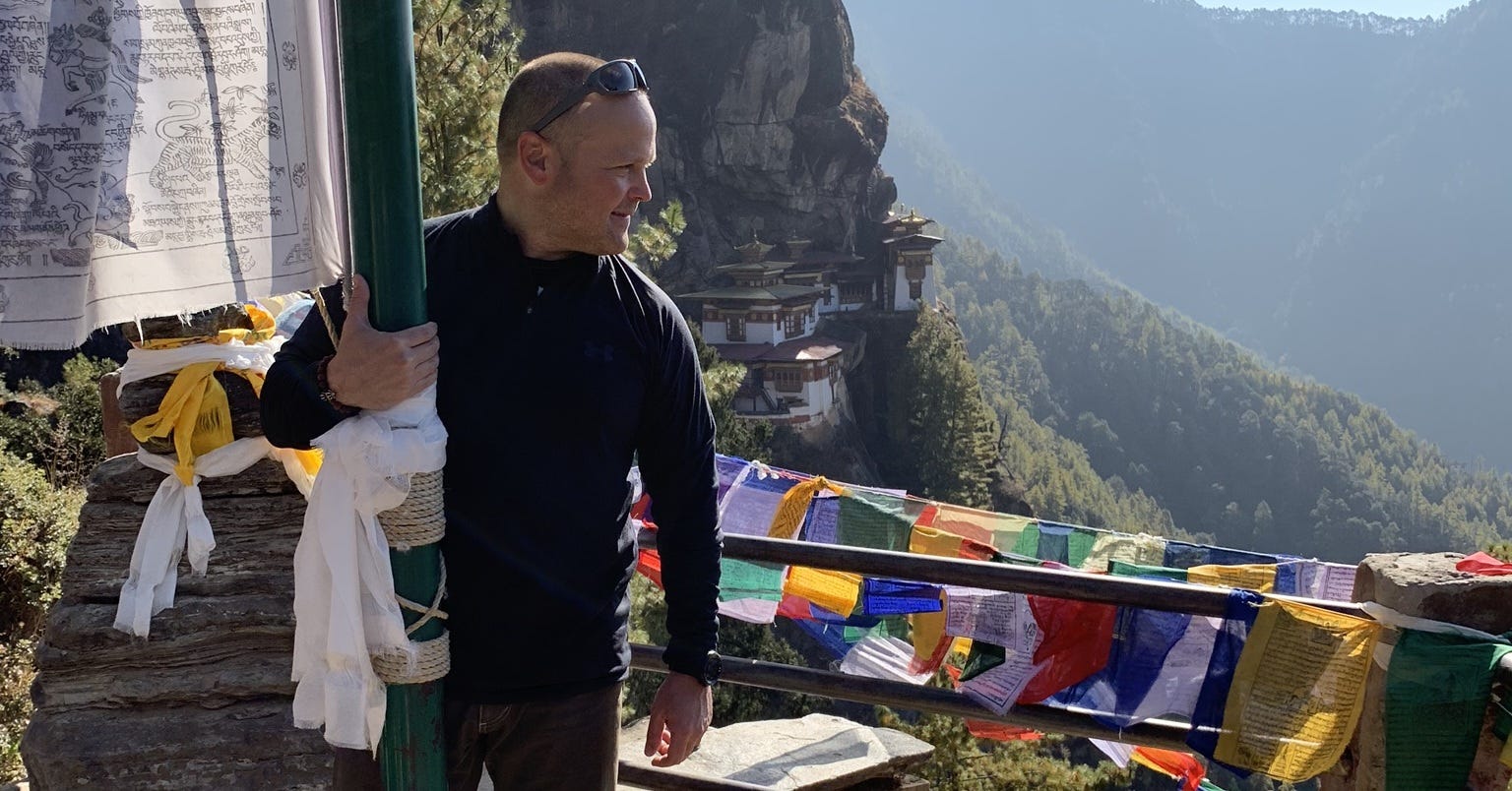
Without the usual titles, responsibilities, and markers of success, I could follow the images and interests that had been waiting beneath them.
I could attend to inner parts long subordinated to the achiever, strategist, builder, and man who always knew what came next. I began exploring the spiritual, psychological, embodied, relational, and philosophical dimensions of myself that success had left little room to express.
This required no rejection of my first-half identity. The entrepreneur, leader, and strategist remain genuine parts of me. I simply had to stop confusing those parts with the whole.
Herein lies the depth psychological meaning of Odysseus becoming Nobody. Identity is necessary, yet it must remain flexible. The persona is an instrument rather than an enemy to be torn away in the pursuit of some imagined authenticity.
Maturity means being able to wear a persona when it serves, set it down when it does not, and resist allowing any single mask to become our only available way of meeting life.
The Stoics arrived here first, and with a sharper image. Persona is the Latin word for the mask an actor wore.
Epictetus told his students to remember that they were performers in a play whose author had assigned the part, and that their work was to play it well. The choosing was never theirs.
What he was after is the line between the role and the one wearing it. That line is what makes it possible to set a role down.
The first half prepares us for this flexibility by giving us something substantial enough to loosen.
We cannot relinquish an ego we never built or step back from a persona we never formed. The achievements, competencies, and identities of the first half create a vessel strong enough to enter the uncertainty of the second.
What once served as the goal eventually becomes material for the larger work of individuation, which is Jung’s name for the slow business of becoming the whole person you actually are rather than the useful one you assembled.
The beggar at his own door
Homer does not leave this in the cave. When Odysseus finally reaches Ithaca he cannot walk in as the king, because the palace is full of men who would kill him in his sleep.
Athena disguises him as an old beggar, bald and bent and dressed in rags, and he stands in his own hall while the suitors mock him and throw food at him.
He learns more in those few days than in ten years at sea. Standing at the foot of his own throne as nothing, he sees precisely who is loyal and who is not.
He takes the throne back only because he agreed, one more time, to be no one.
The second half does not ask us to erase the name. It asks whether we can stop being governed by the need to announce it.
Can the leader stop leading long enough to listen? Can the warrior recognize when the fight has ended?
The expert faces a version of the same test in tolerating uncertainty, and the accomplished person faces it in becoming a beginner again. Underneath every version sits one question: can we finally attend to the parts of the psyche that received little sunlight while the socially successful life was being built?
My travels and inner exploration eventually became part of a re-visioned future. What first appeared to be a departure became a movement toward fuller authorship of my life.
The success belonged to me. It simply was not all of me.
Odysseus’ mistake was never that he had a name. Having discovered the life-saving freedom of becoming Nobody, he could not resist reclaiming that name before the journey required it.
This may be one of the central questions of the second half of life: can we tolerate the temporary disappearance of the self that needs to be admired, credited, certain, or vindicated long enough for the neglected life beneath it to speak?
Sometimes the persona that carried us successfully into the world becomes the very thing standing between us and home.
The practice
If you want to know whether you are still governed by the need to announce your name, try this for one week. In any room where you are not already known, decline to explain what you do. Say less than you could.
Notice what rises when the credential goes unspoken, and how quickly your hand reaches for it anyway.
That discomfort is the size of the distance between who you have been and who is waiting.
Next: The Speech That Killed Odysseus’ Crew
Odysseus loses his entire crew, and not to a monster. They survive a month of starvation on an island with no wind, and then one man talks them into the single act they were explicitly warned against, using the language of courage. The strength that wins the first half of a life is the strength that gives that speech. It is still giving it, in boardrooms, at the end of bad quarters.
Reading order
All five essays were published on August 2, 2026, rather than spaced across a month. They were written to be read together, and this is the order I would suggest.
You Cannot Return Home as the Person Who Left. Odysseus in the cave, my third exit, and why the self that built your success is the wrong one to author what comes next. (this essay)
The Speech That Killed Odysseus’ Crew. The strength that wins the first half of a life and wrecks the season after it.
AI Will Reveal You. What gets scarce when analysis becomes free.
The Most Dangerous Moment in a Successful Life. What this publication believes, and why it exists.
Ninety Days for the Life You Have Only Been Researching. The practical one. Six steps, a two-column log, and one question worth asking.